Think of a fund administrator as the operational engine of an investment fund. They are a specialized third-party firm that takes care of all the critical, non-investment tasks—the middle- and back-office work that keeps a fund running smoothly. This frees up the fund manager to do what they do best: focus on investment strategy, deal-making, and generating returns.
The Operational Backbone of Your Fund

Let's use an analogy. Imagine an investment fund is a sophisticated airliner. The fund manager is the pilot, expertly navigating the markets to reach the destination of high returns. But a pilot can't fly the plane while also managing air traffic control, handling baggage, ticketing passengers, and performing aircraft maintenance. Juggling all that would be a recipe for disaster.
That's where the fund administrator comes in. They are the entire ground crew and control tower rolled into one. They form the fund's operational backbone, making sure every non-investment process is handled efficiently, accurately, and in full compliance with the rules. Their work provides the solid, reliable structure that builds crucial trust with investors, auditors, and regulators.
What Do They Actually Do?
A fund administrator's role is incredibly broad, touching nearly every aspect of a fund's life cycle. Their primary job is to provide independent verification and administration, ensuring the fund's books are accurate and its operations are sound.
Here’s a look at their core responsibilities:
- Fund Accounting: This is the big one. They calculate the fund's Net Asset Value (NAV), manage the general ledger, and prepare all the essential financial statements.
- Investor Services: They handle everything related to the fund's investors (Limited Partners or LPs). This includes processing subscriptions, managing capital calls and distributions, and often acting as the main point of contact for LP inquiries.
- Regulatory Compliance: They help the fund navigate a maze of complex regulations. This means ensuring compliance with rules like FATCA/CRS and AIFMD and handling the required regulatory filings.
- Treasury Services: They manage the fund's cash, processing payments to vendors and portfolio companies, and reconciling all bank accounts to ensure everything adds up.
By handing these functions over to a specialist, fund managers get immediate access to deep expertise and sophisticated technology. Building that kind of operational integrity in-house would be incredibly expensive and time-consuming. This partnership allows a fund to scale efficiently and project an institutional-grade image from its very first day.
What Fund Administrators Actually Do
So, we know they're the "operational backbone" of a fund, but what does a fund administrator really do day in and day out? Their work is the bedrock of a fund's integrity. They make sure every number is right, every investor is looked after, and every regulatory box is ticked. These aren't just back-office chores; they're the essential tasks that build and maintain trust with investors.
The single most critical job they have is calculating the fund's Net Asset Value (NAV). You can think of the NAV as the fund's official "share price." It’s a meticulous calculation—all assets minus all liabilities, divided by the number of shares—that gives a precise snapshot of the fund's value at a specific moment. This isn't just a number on a spreadsheet; it's the metric that drives investor reporting and performance tracking.
Get the NAV wrong, and you're looking at incorrect performance fees, unhappy investors, and a damaged reputation. That’s precisely why having an independent, third-party administrator handle this calculation is the gold standard in the industry.
Core Service Areas
A fund administrator's responsibilities fall into a few key areas, all working together to create a seamless back-office engine that lets the fund manager focus on investing.
Here’s a quick look at how their main services support a fund manager's goals.
Fund Administrator Core Service Breakdown
These functions come together to provide a complete operational solution, allowing managers to scale without getting bogged down in administrative details.
The demand for these services is exploding. The global asset management industry's assets under management recently hit a staggering $135 trillion, jumping by $15 trillion in just a single year. This growth puts immense pressure on fund operations, with industry data showing that nearly 45% of firms now manage $5 billion or more. You can explore more about asset management industry growth on mckinsey.com.
To handle this scale, many administrators now rely on modern treasury platforms to oversee bank accounts, process payments, and manage cash flows with precision.
Navigating Regulatory Complexity
Finally, one of the most valuable roles an administrator plays is keeping the fund compliant. The rules governing investment funds are a tangled web—they're constantly changing and vary wildly from one country to the next.
An administrator acts as a fund’s compliance shield, staying on top of complex requirements like FATCA/CRS, Form PF, and AIFMD. They prepare and submit the necessary regulatory filings, helping managers avoid costly fines and sanctions.
Trying to keep this level of specialized knowledge in-house is incredibly difficult and expensive. By partnering with an administrator, fund managers get a dedicated team of experts whose entire job is to navigate this intricate world. This ensures the fund stays in good standing with regulators everywhere, which is fundamental to keeping its license to operate.
Differentiating Roles in the Fund Ecosystem
The investment world is a lot like a high-stakes team sport. For the team—the fund—to win, every player needs to execute their specific role perfectly. The fund administrator is the operational quarterback, but several other key players on the field have equally critical, and very distinct, jobs.
Confusing these roles is a common pitfall. While they all work together, their responsibilities are intentionally separate to create a system of checks and balances. Let's break down who does what.
Fund Administrator vs Custodian vs Transfer Agent
To really get a handle on what a fund administrator brings to the table, it’s helpful to see how their duties stack up against the other essential service providers. Each has a clear mandate designed to protect the fund and its investors in different ways.
This separation of duties is the bedrock of good fund governance. It’s not just best practice; it’s something sophisticated investors specifically look for during their due diligence. They want to see that no single entity has too much control.
Breaking Down the Key Players
Let's dive a little deeper into these roles.
The Custodian: The VaultThink of a custodian as the Fort Knox for a fund's assets. Their primary, non-negotiable job is to hold and safeguard all the fund's securities—stocks, bonds, private equity stakes, and cash. They are the ultimate guardians, ensuring the assets are kept safe and completely separate from the fund manager's own accounts. While the administrator tracks the value of these assets, the custodian physically holds them.
The Transfer Agent: The Official RosterThe transfer agent is the definitive record-keeper of the fund's investors (or Limited Partners). They manage the official "cap table" or list of who owns what. When an LP subscribes to the fund or sells their interest, the transfer agent is the one who updates the ownership records and handles the related paperwork. The administrator's investor services team works with this data, but the transfer agent maintains the master ownership ledger.
The chart below gives you a good sense of how a fund administrator’s own team is typically structured to handle its core responsibilities.
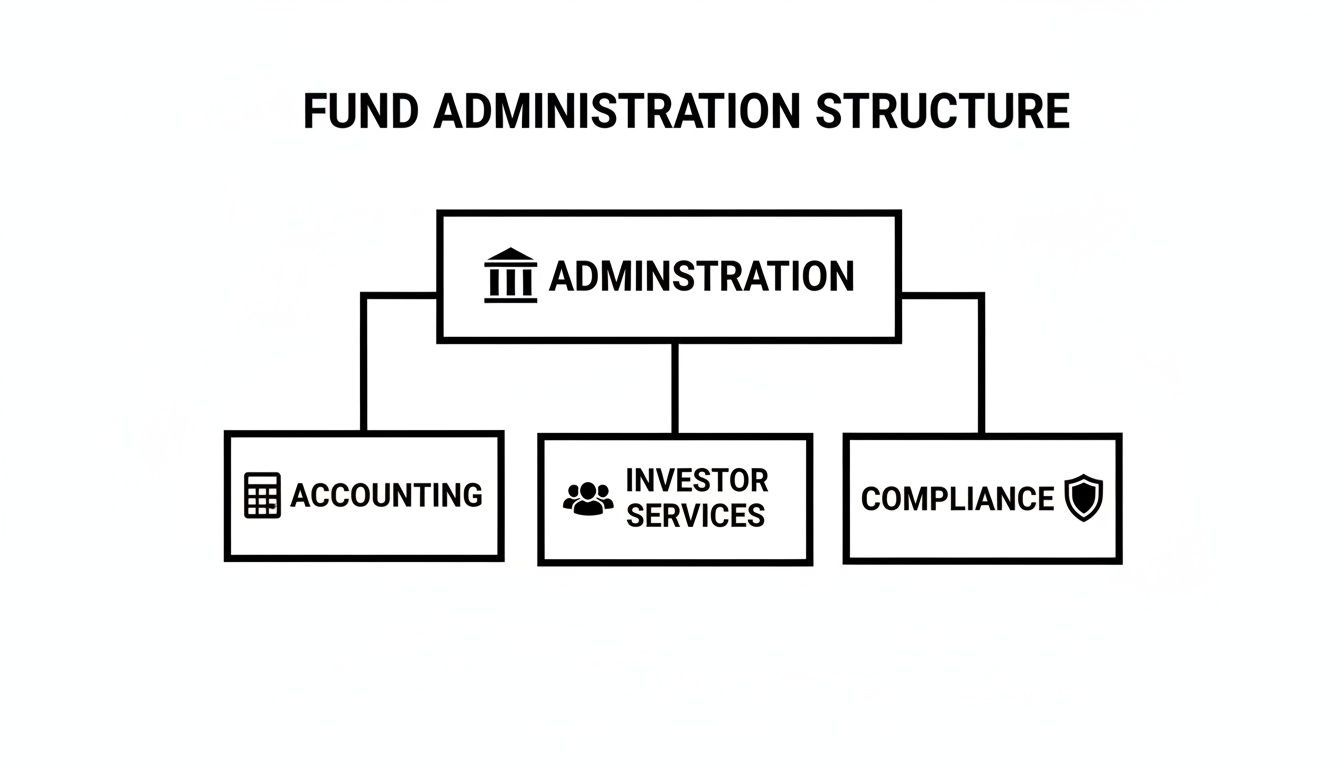
As you can see, the administrator's world is organized into distinct pillars—accounting, investor services, and compliance—that support the entire fund structure.
One other key player, especially for hedge funds, is the Prime Broker. They act as the fund’s primary trading partner, providing a suite of services like trade execution, financing (leverage), and securities lending.
Each of these partners provides a vital piece of the operational puzzle. The administrator calculates the NAV, the custodian protects the assets, and the transfer agent maintains the official investor records. For LPs, this all comes together when they can easily view their capital accounts and performance data through a modern investor portal. This clarity ensures everyone knows their position, creating a transparent and robust framework for the fund.
The Strategic Shift to Outsourcing
So, why are so many funds choosing to partner with a third-party administrator instead of building out their own back office? It's not just about cutting costs anymore. Outsourcing has become a serious strategic move that lets fund managers get back to what they do best: generating alpha.
Let's be honest, building an internal operations team from scratch is a huge undertaking. You're looking at a massive investment in specialized talent, expensive software, and the constant need for training to keep up with regulatory changes.
By bringing in an external fund administrator, a fund gets immediate access to a whole team of seasoned pros and top-tier infrastructure. This lets you sidestep the headache and the enormous expense of hiring, training, and retaining a dedicated in-house staff for critical tasks like NAV calculation, compliance checks, and investor reporting.
Accelerating Credibility and Sharpening Focus
For new and emerging managers, outsourcing is a total game-changer. It instantly gives you a stamp of credibility with institutional investors, who see independent administration as a non-negotiable part of good governance. Having a third-party administrator acts as an unbiased check on your numbers, ensuring everything is accurate and transparent. That builds a ton of trust with your LPs.
This one decision frees up the core fund team to pour all their energy into the activities that actually drive returns:
- Investment Strategy: Finding great deals, digging deep into due diligence, and making smart investment calls.
- Portfolio Management: Rolling up their sleeves and working directly with portfolio companies to create real value.
- Investor Relations: Building strong relationships with LPs and keeping fundraising momentum going.
The core benefit is simple: outsourcing turns a fund’s fixed operational costs into a variable expense, making it much easier to scale. Managers can take on more complex deals and grow AUM without getting buried in back-office work, keeping their eyes on the prize—performance.
A Clear Industry Trend
The numbers don't lie. This shift away from self-administration is happening across the industry. The number of private equity funds using independent administrators has shot up at a 22% compound annual growth rate (CAGR). That completely overshadows the 11% CAGR for funds that still do it all themselves.
Even more telling? The number of PE funds that switched from an in-house model to an external administrator jumped by 33% in just one year. That's a massive signal of where the industry is heading. You can discover more about this PE administration trend and what it means for the market.
Ultimately, this move is about smart risk management and efficiency. A good external administrator stays on top of the constantly changing regulatory maze, protecting the fund from costly compliance mistakes. When you're thinking about making this move, you need to do your homework; using a practical guide to vendor due diligence can help you pick the right partner. In the end, many funds find that teaming up with professional services experts gives them the specialized firepower they need to thrive.
How to Choose the Right Fund Administrator

Picking a fund administration partner is one of the most important operational decisions a fund manager will ever make. Get it right, and you’ve got a strategic asset that helps you scale and keeps investors happy. But get it wrong, and you're staring down the barrel of reporting errors, frustrated LPs, and a whole lot of operational pain.
This isn’t a decision to be taken lightly or based on price alone. You’re entrusting the financial backbone of your fund to this partner. That means your due diligence needs to be watertight, focusing on their real-world experience, the quality of their technology, and whether they can actually keep up as you grow.
Vet Their Expertise and Specialization
Let's be clear: not all fund administrators are the same. Each asset class—private equity, venture capital, real estate, private debt—has its own set of rules and complexities when it comes to accounting, valuation, and operations. Your very first filter should be finding a partner with deep, proven experience in your specific sandbox.
An administrator who lives and breathes hedge funds probably isn't the right fit to handle the intricate capital calls or waterfall calculations for a private equity fund. Don't be shy during the evaluation process. Ask for case studies and, more importantly, talk to references from funds that look a lot like yours in terms of size, strategy, and complexity. You need someone who already speaks your language.
Scrutinize Their Technology Stack
These days, an administrator's tech is just as critical as its people. A modern, secure, and well-integrated technology platform is absolutely non-negotiable. It's what ensures your data is accurate, your fund’s information is safe, and your Limited Partners get the transparency they now demand.
When you're kicking the tires, be sure to ask:
- Investor Portal: What does it look like? Is it intuitive and secure for LPs who need to pull reports or check their capital account statements?
- Data Integration: How painful is it to get data out of their system and into your own portfolio management tools? Can it be automated?
- Cybersecurity: What are their security protocols? Can they show you a recent, independent security audit?
The whole point is to find a partner whose technology creates a single source of truth—one that simplifies life for both your internal team and your investors. An administrator's ability to eliminate duplicate data entry and manual work should be a huge factor in your decision.
The cost of getting this wrong is staggering. A recent survey revealed that a whopping 43% of a private market staff’s time is eaten up by issues caused by juggling multiple administrators. It's no surprise, then, that 62% of firms now say an administrator’s ability to reduce data duplication is a top priority. You can dig into more findings on fund administration efficiency to see just how much this matters.
This reality makes a tough tech review essential. You need a partner who delivers clean, reliable data that flows where it needs to go, not one who creates more operational drag. A tech-forward administrator isn't just a solution for today; they're a partner who can adapt to whatever comes next.
Turning Administrative Data Into a Strategic Asset
The data you get from your fund administrator is so much more than a compliance checkbox. For a long time, this information was trapped in static PDF reports—a goldmine of strategic insight just waiting to be tapped. Now, smart fund managers are unlocking that value by piping administrative data directly into powerful analytics platforms.
This single connection turns a back-office chore into a front-office superpower. Instead of someone manually typing numbers into a spreadsheet, clean and verified data flows automatically from your administrator into a central hub. What used to be backward-looking reports become living, breathing dashboards.
From Static Reports to Dynamic Insights
With this setup, you can track your most important KPIs whenever you want. Forget waiting for the quarterly report to land in your inbox. You can analyze performance, check on portfolio company metrics, and model cash flows in an instant. This simple workflow transforms administrative data into fuel for making smarter, faster decisions.
For example, platforms like Vestberry use these integrations to create a single source of truth for the entire firm.
The image here shows how a direct API connection pulls everything—financial data, capital accounts, and transactions—into one organized place. This seamless flow means your analytics are always running on the most current, audited numbers from your fund administrator.
That link between administration and analytics is everything. It ensures your team's decisions are based on verified financials, not on some outdated or fragmented spreadsheet. It just builds a more resilient, data-driven investment process.
This approach doesn't just save hundreds of hours on manual reporting; it fundamentally deepens your portfolio intelligence. You can learn more about how to get this kind of clarity by exploring the benefits of dedicated portfolio management software.
Ultimately, it helps your fund become more agile, making it easier to spot both risks and opportunities as they emerge.
A Few Common Questions About Fund Administration
Diving into the world of fund administration often brings up a few practical questions. It’s one thing to understand what they do, but it's another to know how it actually works in terms of cost, timing, and whether it’s even right for your fund.
Let's clear up some of the most common queries managers have before they take the leap.
What Does a Fund Administrator Typically Cost?
There's no single price tag for fund administration; the cost really hinges on your fund's size, complexity, and how active it is. Think of it less like a fixed product and more like a tailored service.
You'll generally come across a few pricing structures:
- AUM-Based Fee: This is a classic model where you pay a percentage of your Assets Under Management (AUM). The range is pretty wide, but it often falls between 10 to 25 basis points a year.
- Flat Fee: Some administrators, especially those working with smaller or simpler funds, offer a fixed annual fee. The big advantage here is predictability—you know exactly what you're paying.
- Hybrid Model: This is a mix of both, usually a base flat fee plus additional charges based on transaction volume or for specific, one-off services.
Don't forget to ask about the extras. It's common to see one-time setup fees, extra costs for complex compliance filings, or charges for custom reporting that goes beyond their standard package.
Is a Fund Administrator a Good Idea for Small or Emerging Funds?
Absolutely. In fact, for emerging managers, it’s a game-changing strategic move. Outsourcing your back office gives you instant access to the kind of institutional-grade infrastructure and expertise that LPs expect to see. It’s an immediate credibility boost.
Partnering with an administrator lets a small team punch well above its weight. You can focus your energy on what you do best—finding great investments and raising capital—instead of getting bogged down in operational quicksand. It helps you compete from day one without the massive overhead of an in-house team.
How Long Does It Take to Get Onboarded?
Getting everything set up and running smoothly usually takes anywhere from four weeks to three months. What determines the timeline? It really comes down to the complexity of your fund structure, how clean and accessible your historical financial records are, and the time needed for all the legal and compliance groundwork.
A painless transition really depends on close collaboration. The administrator’s onboarding team needs to work hand-in-glove with your own team to make sure every piece of data is migrated correctly and all the new workflows are locked in.
Turn your fund's fragmented data into actionable portfolio intelligence with Vestberry. Our platform integrates seamlessly with your fund administrator, creating a single source of truth to drive faster, data-backed decisions. Learn more about how Vestberry connects your data.